How to use this table
Read down the left column until you find the conditions closest to yours, then look across for the equipment that tends to match. The table does not replace judgment; it is a quick way to see why one machine suits a job and another does not. Where two options appear, the first handles bulk water and the second finishes what is left.
Depth is measured at the lowest point of the room. A slab that slopes toward a floor drain or a sump pit means water collects there first, so your deepest reading may be much smaller than the room average.
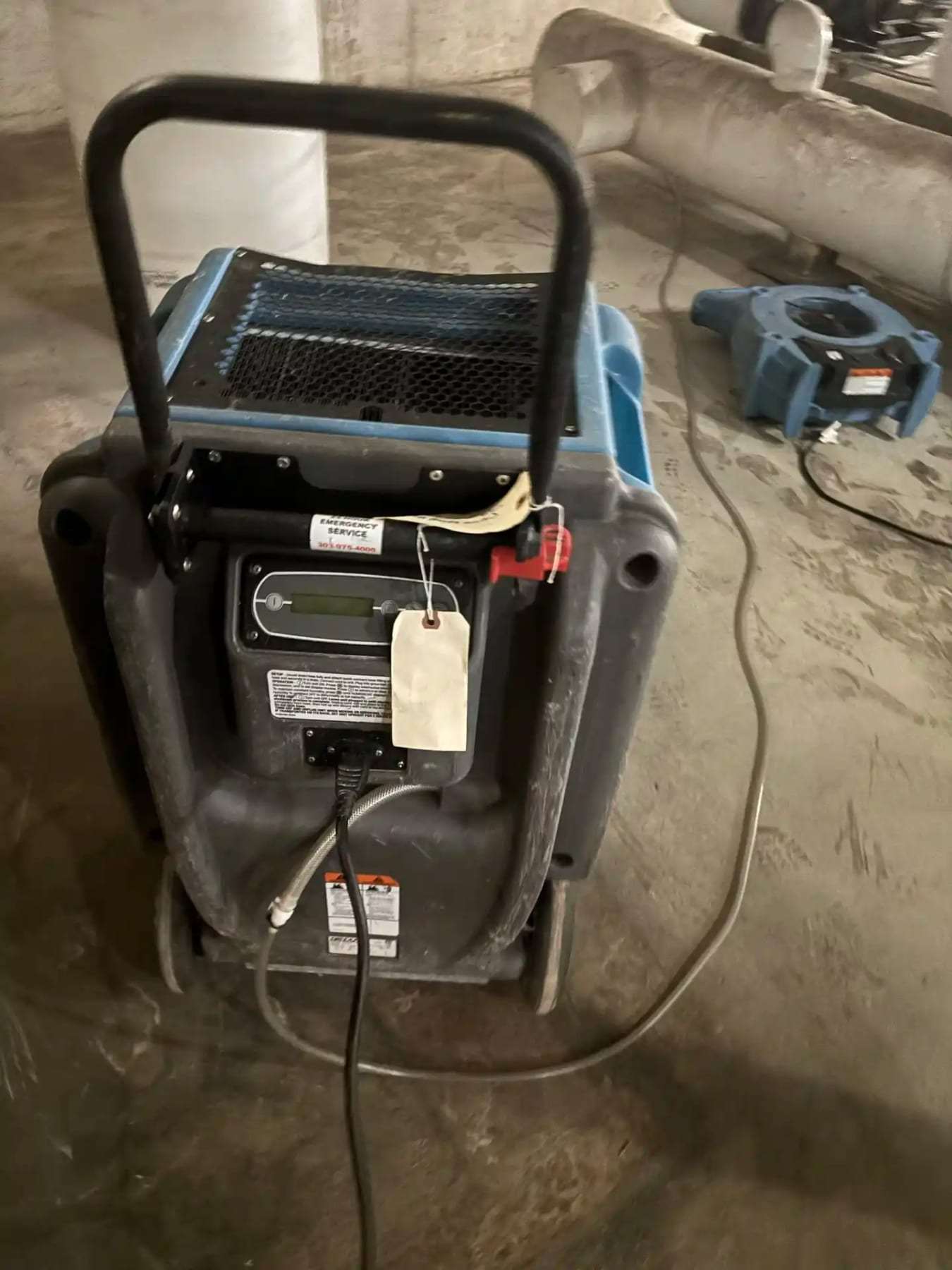
Submersible pump and an air mover on a wet concrete floor. One example of what this stage can look like; it is not a job connected to this site.
Situation to equipment
- Situation
- Under half an inch across a bare slab
- Usual equipment
- Squeegee and wet-dry vacuum
- Left behind
- Damp film
- Needs next
- Airflow and a dehumidifier
- Situation
- Half an inch to three inches, whole room
- Usual equipment
- Submersible pump, then vacuum
- Left behind
- Quarter inch
- Needs next
- Wand pass on carpet, pad check
- Situation
- Over three inches, stairwell or pit
- Usual equipment
- Larger pump with long discharge hose
- Left behind
- Thin layer
- Needs next
- Vacuum and squeegee
- Situation
- Soaked carpet over pad
- Usual equipment
- Weighted extraction wand, or lift and cut
- Left behind
- Pad moisture
- Needs next
- Pad removal, slab drying
- Situation
- Silty window well water
- Usual equipment
- Trash pump
- Left behind
- Silt on the floor
- Needs next
- Shovel, rinse and extraction
- Situation
- Crawlspace with low clearance
- Usual equipment
- Transfer pump with suction hose
- Left behind
- Pools in dips
- Needs next
- Small wand or sponge-out, ventilation
- Situation
- Backup through a floor drain
- Usual equipment
- Equipment run by protected people only
- Left behind
- Contaminated residue
- Needs next
- Disinfection and material removal
Typical pairings; conditions on site can change the answer.
Before choosing a machine
- Measure the deepest point and the area in rough feet.
- Decide whether the water is clean, gray or black.
- Locate where the discharge hose can run downhill and away.
- Check that the circuit used is dry and protected.
- Know the flooring type, because carpet needs a different tool than tile.
- Plan where to empty a canister if a vacuum is used.
Equipment words
- Submersible pump
- A sealed pump that sits in the water and pushes it out through a hose.
- Trash pump
- A pump with a large intake that tolerates grit and small debris.
- Transfer pump
- A pump that sits above the water and pulls it through a suction hose.
- Extraction wand
- A hand tool with strong suction used to pull water from carpet and flat surfaces.
- Lift
- The vertical distance the water must be raised on its way to the outlet.
Common questions
Which machine is best overall?
None. Depth, debris and flooring decide, and most jobs use a pump for bulk water and a vacuum or wand for the finish.
Why does a pump leave water behind?
A pump loses suction when the level drops below its intake, usually leaving a thin layer that needs a different tool.
General information for Wheat Ridge, not a quote or professional advice. In an emergency, call 911.